Skip to music
At our Peak

At our Peak studio / November 9, 2026

Inside the
psycho.sys.exe
visualizer.

How frequency analysis, transient events and stereo waveforms became part of a violet-and-black world.

Studio notes by At our Peak. This case study documents the later Signal Cinema local production pass; the release page links to the official YouTube upload.

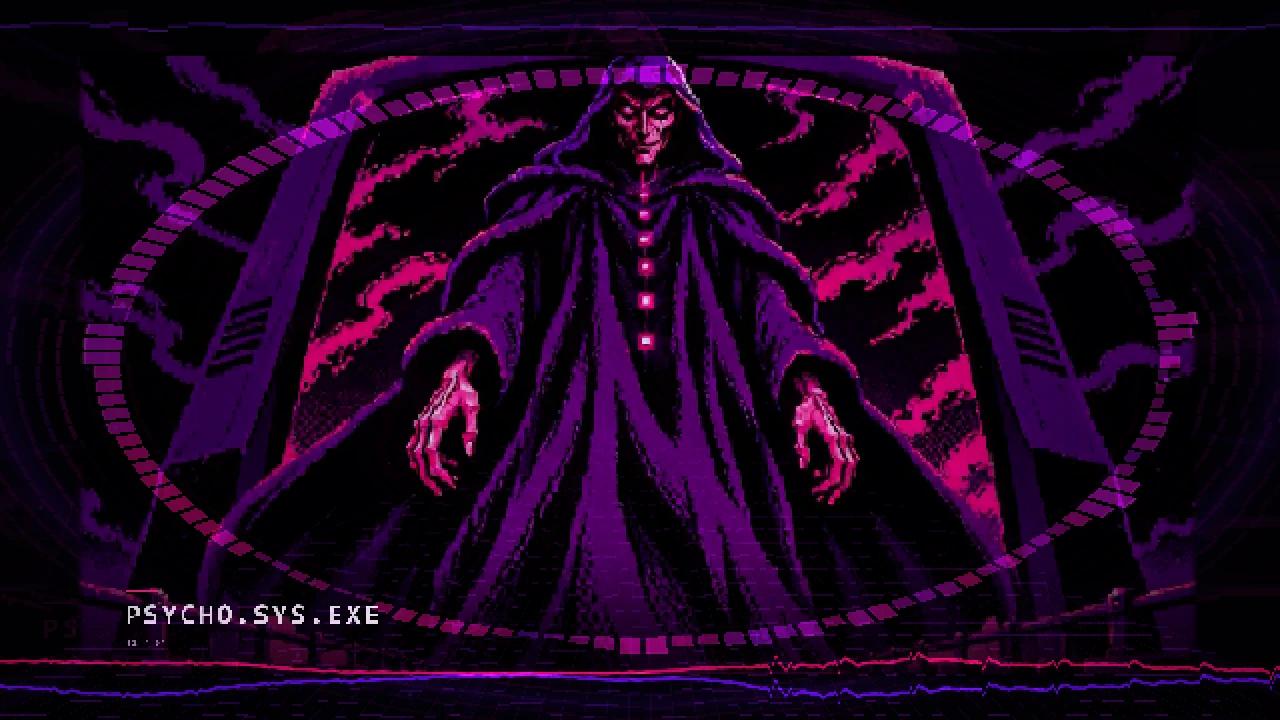
A frame from the psycho.sys.exe Signal Cinema studio pass, with the hooded figure inside reactive spectral geometry
Generated artwork and an existing picture edit meet a custom audio-reactive graphics layer.

The problem: artwork can hold still while the song moves.

psycho.sys.exe has a strong visual identity: a gaunt hooded figure, luminous magenta eyes, skeletal hands and a coarse pixel-art surface. The production challenge was to make that world participate in the music while keeping the character readable.

The later Signal Cinema pass retained an 80-shot picture edit with 42 compositions. Its new layer followed the recording’s changing frequency content, attacks and stereo waveforms. Instead of replacing the artwork every time the music changed, the surrounding geometry could carry part of the movement.

Start with the complete mix.

The analysis divided the stereo recording into 128 logarithmically spaced frequency bands spanning 20 Hz to 20 kHz. A longer analysis window followed sustained energy. A shorter one tracked faster changes across eight transient regions. The stereo channels were combined as power for the spectral analysis, so opposing-phase content would not simply cancel out of the visual signal.

Different signals had different jobs. Lower-frequency activity affected depth and pressure around the picture. Frequency-local attacks left travelling contours. Sustained energy fed individual ribs and particles, while the actual left and right PCM waveforms formed separate foreground strands.

This operates on a mixed recording. A bass note and a kick can both contribute energy to the low bands. The method describes frequency regions and events; assigning each event to a named instrument would require additional analysis.

Three forms, one world.

The geometry moved between an iris, a diamond lattice and a rectangular signal chamber. At picture cuts, forms interpolated over 1.4 seconds. That gave the sequence changing architecture while keeping its palette and character identity connected.

The picture edit was decoded at 30 frames per second. The reactive graphics updated at 60 frames per second. The extra updates belonged to the audio-reactive layer, while the underlying edit kept its existing timing.

Rendering started on a 640 × 360 graphics grid, expanded exactly four times to 2560 × 1440 with nearest-neighbour scaling. The coarse surface was a deliberate pixel-art choice. A smooth scaling filter would have changed the character of the original work.
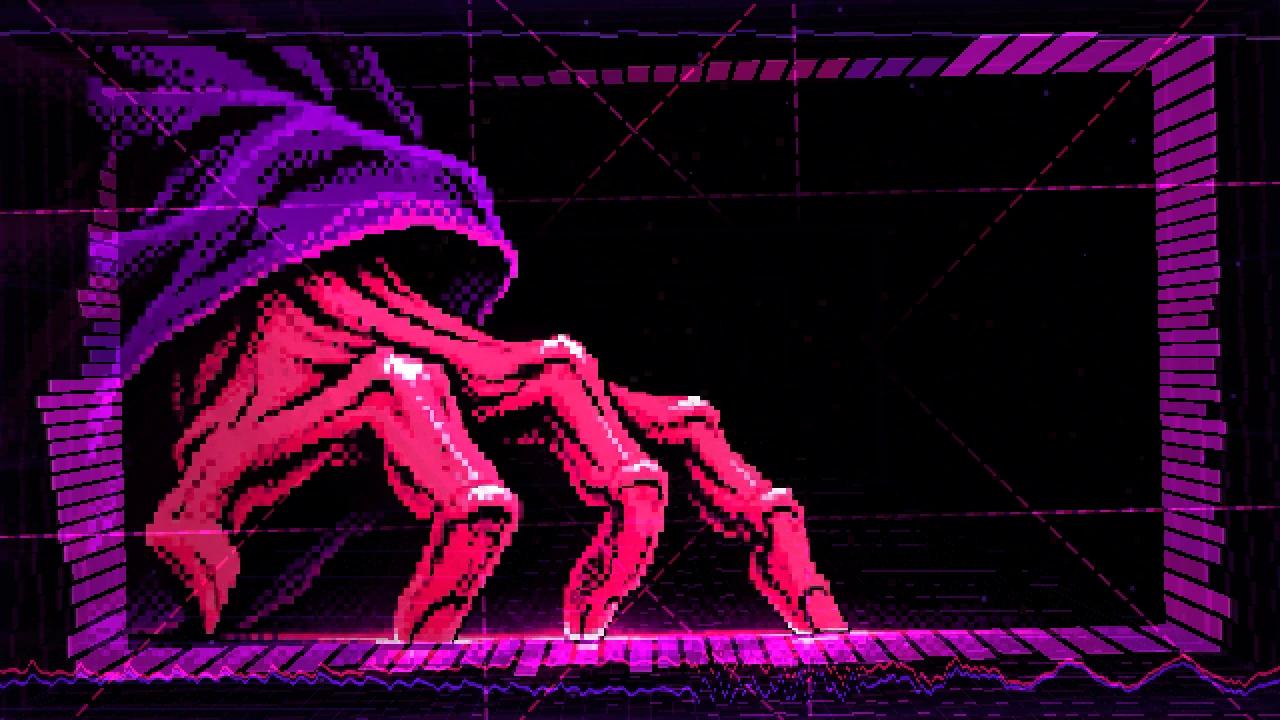
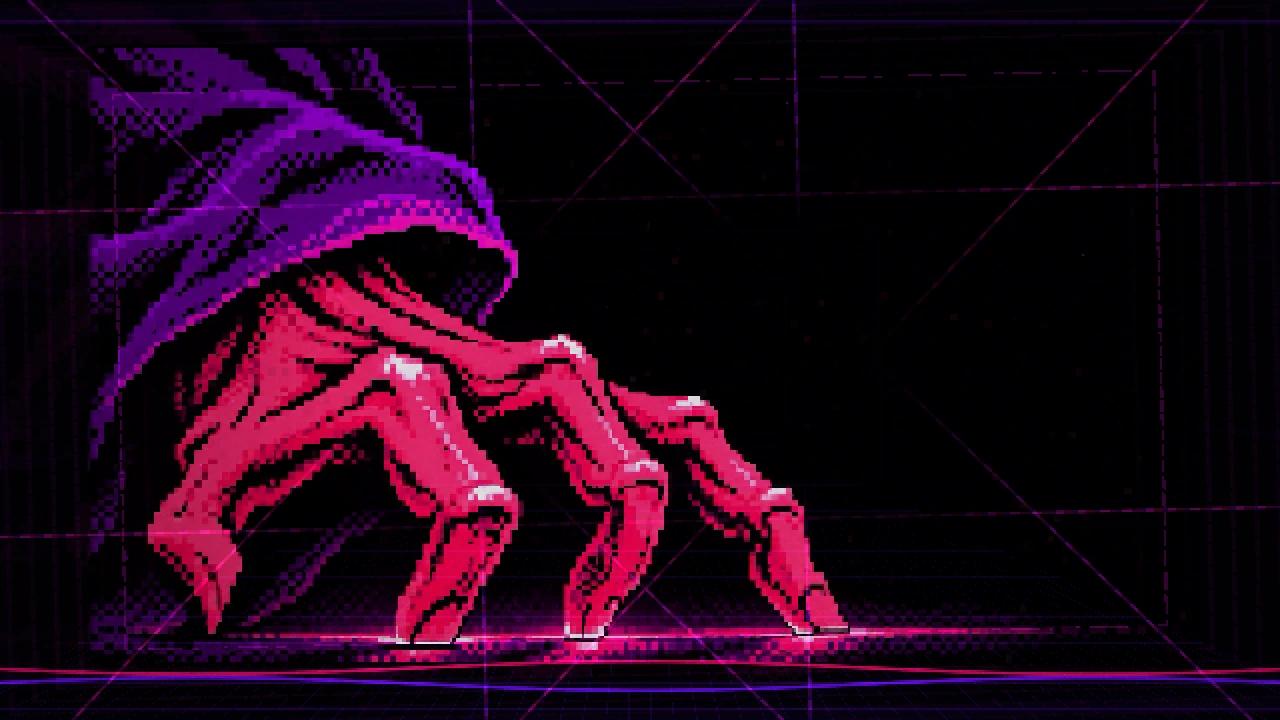
Same picture. Same time. Different input.

These frames use the same source picture and the same video time: 83.633 seconds into the studio sequence. In the first frame, the music-derived spectrum, history, waveforms and intensity are active. In the control, those inputs are zeroed.

Same-frame treatment with real audio analysis enabled: bright spectral ribs, attack planes and stereo waveforms
Audio analysis enabled.
Same-frame control with music-derived inputs disabled: source artwork remains while reactive ribs and waveform movement recede
Music-derived inputs zeroed.

At this sample, the mean absolute difference was 14.43 levels per RGB channel on a 0–255 scale; 23.12% of channels changed by more than 10 levels. That establishes that the audio inputs materially affect the frame. It does not measure musical quality, listener preference or an isolated instrument’s accuracy.

Protect the recording while finishing the picture.

The studio master used H.264 picture with lossless FLAC audio. Verification decoded the master audio and compared its PCM hash with the combined original WAV. That comparison matched. The upload copy reused the picture stream and encoded the audio as 384 kbps AAC.

The complete export also passed a full decode check. Visual review sampled 16 encoded scenes across the sequence and 32 within-shot motion frames. Those checks provide a concrete review scope; they are not described as an uninterrupted full-length viewing session.

What the process adds.

AI-created imagery is one material in this production. The edit, frequency mapping, rendering choices, scene transitions and verification determine how that material behaves over time. The result is a particular visual interpretation of the recording, with choices that can be inspected rather than reduced to a label.

For the music itself, visit the psycho.sys.exe release page. For another entry into the project, browse the original AI music listening guide or the release catalog.

At our Peak

Original AI-assisted music. Published by At our Peak.
Electronic worlds, classical resonance and heavier departures.

Listen links record an anonymous outbound click, not a completed listen. No tracking cookies or visitor IDs are set. Platform request logs may include standard technical data.

thesecretlab studio ↗